

Cogito sic sum
Coming to grips with the overarching pessimism of Carmy, the Bear.
The concept of self-fulfilling prophecies have taken my fancy as of late. The idea first found its way to me on Facebook, of all places, where one of the last remaining threads that’s preventing me from fully cutting my cord to the app comes the Mayor – my favorite professor from University.
The Mayor, an ever-enigmatic bastion of sociology in himself, shared a refreshing sentiment on mental health issues taking center stage in the modern zeitgeist. While the phenomenon has its obvious benefit of de-stigmatizing a historically dismissed classification of illness, experts in the field of sociology have cited the negative by-product of people turning to self-diagnosis as a means to participate in the topic. The notion is that in the information age, people have an inclination to take matters into their own hands with the perceived power they, or the social media posts, have over anything. If a TikTok video lists down symptoms of social anxiety and Person A identifies with maybe one or two of those, they now have more of a tendency to self-diagnose themselves with social anxiety even if they don’t necessarily meet the breadth and intensity of the criteria as defined by professionals. In this way, a self-fulfilling prophecy takes into effect, wherein Person A leans into that train of thought to identify with. This introduces the danger of delaying proper care and misrepresenting people who actually have such issues. Mayor’s not trying to argue that putting a platform on mental health is bad per se, but that we need to be extra careful with the messaging.
Both concepts have found to be monumental in defining the cultural climate in history, but unlike the appropriation of mental health in the mainstream, self-fulfilling prophecies have been around for time eternal. At its core, prophecies are rooted on the belief of supernatural entities communicating a predictive message on a person, and in turn, that person would make it their life’s journey in pursuit of that. Its element of mystique makes for a driving influence central to religious text and pioneering civilizations.
Adding dramatic irony to prophecies is when they’re enacted upon by their own host, perhaps the most famous example of which is that of the tragedy of Oedipus Rex by the Greek playwright Sophocles. Oedipus, in an effort to escape the destiny of killing his father and sleeping with his mother, runs away from his parents to tack on a new life altogether. His journey saw him killing a stranger and marrying the wife of the deceased, a series of events which was later revealed to him as fulfillment of the very prophecy he was determined to escape.
The postulation of self-fulfilling prophecies, it seems, is that the more a person thinks of or internalizes an outcome, the more drawn their actions are towards that very result, whether it be intentional or not. In modern times, we can allude to the act of speaking (or in this case, thinking) things into existence, which is as good as much as it is bad.
For better or for worse, this concept fits to a tee in the modern Greek tragedy as portrayed in FX’s The Bear, an odyssey of a show that follows the nicknamesake of Carmen Berzatto, a chef mired in the heat within and outside the confines of the kitchen. As the story goes, the anxiety of Carmy – as he’s affectionately called by the people in his day-to-day – is an apparent theme in the show’s running, where his dreams of reestablishing his family restaurant and reconciling with his past from Chicago and back are riddled by forces both external and internal to him.
In a nonlinear sequence of events, The Bear takes us back and forth across Carmy’s journey that mirrors a blind, course-based meal that sees no end and knows no consistent trend as the flavors of life go; one in which he finds himself having to figure out what to do of his impeccable culinary acumen that has earned him proper recognition and pockets of glee, while having to withstand family troubles, career stress and pressure, and the untimely death of his brother Mikey. It’s this very death that prompted our protagonist to make his return to Chicago, in particular, The Beef – a humble, chaotic, debt-ridden sandwich shop left behind by the deceased – in an effort to reestablish Mikey’s slice of life. This established the focus for its pilot season, a tone-setter for Carmy’s present earmarked by what remains to be some of the best screaming matches on TV. Not ideal for our hero, but hey, nothing screams a comedy-drama better than an impassioned rebuke of interrupting an agitated Carmy over project donuts during a busy shift.
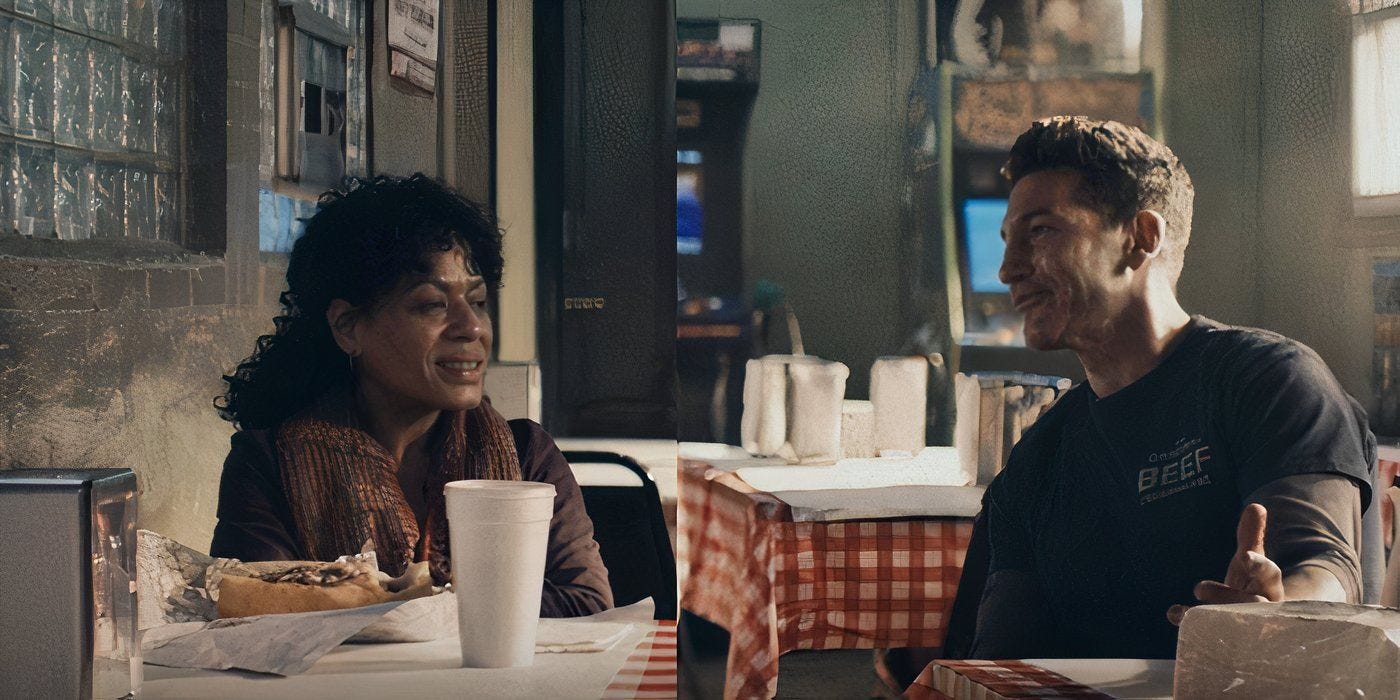
Where Season 1 established the present, Season 2 looked ahead towards Carmy and his upstart sous chef Sydney’s anxious future to upscale the restaurant from reeling at the enigmatic Mikey’s death to aiming for a Michelin star. It’s in this season where we begin to see and understand Carmy’s rage in a new light as more of his anxious side comes into play. In tying the bow, Season 3 marinates further into Carmy’s past as part of an acknowledgement to deal with his trauma.
And look, Carmy’s talented as fuck. He’s handsome, he’s a good conversation and all, but he often finds himself muddied in the worry of it all to leverage what everyone else admires him for. He self-sabotages because he thinks he doesn’t deserve good things, in anticipation of the other shoe to drop, a by-product of a traumatic upbringing where you almost always expect the worst to happen out of thin air. He could be having a perfectly tense family reunion until his mother drives a car right into the living room. Or he could be zeroed in on a fancy dish only to be deemed worthless by his douchebag of a boss when he leasts expects it.
And more often than not, he succeeds in fulfilling his own prophecy.
What I admire the most about The Bear is how accurate it’s portrayed the nuances of anxiety. It’s way past mere physical cues, and offers an exploratory view into the way people riddled with this think and operate. The cinematography and screenplay typify this illustration this with an anti-chronological view of Carmy’s past, present, and future apprehension, with scenes that feel like the direct point of view of somebody embroiled in the heat of it all. It’s in the every moment of tension that had been perfectly captured, whether it be a tense shift at work (Braciole, S01E10), a hostile family gathering (Fishes, S02E06), a last line of hope (Napkins, S03E06), or a nervous reconciliation (Ice Chips, S03E08).
And in a representative symptom of anxiety, I can’t help but look back at the monumental last episode of the second season (The Bear, S02E10), where Carmy finds himself accidentally locked inside the kitchen’s refrigerator while his restaurant enjoys a busy shift in its anticipated first night. It seemed emblematic that until the very end, what was something worth celebrating was suppressed by the long-winded mental battle of Carmy’s, and his first instinct is to put up a wall and maintain a careful distance from everyone and everything, intentional or not. The Bear – the restaurant – may have cleaned its walls, revamped its menu, and rebranded, but the self-anointed prophecy remains in its wake.
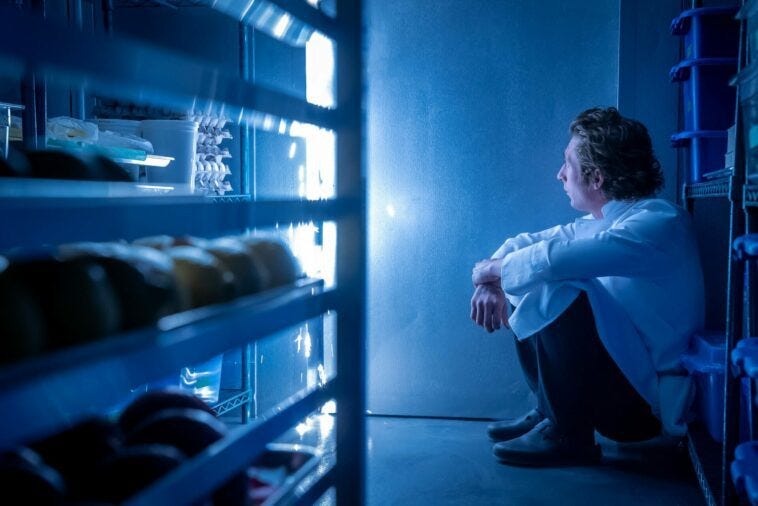
While Carmy roams outside the vault in pursuit of greater glory in the culinary world, the real challenge is unlocking a tougher one inside his head that no amount of Michelin stars can decipher; peace of mind – if he gets to figure it out, that is – and I’m telling you now, that’s a tall order neither a prophet nor a talented sous chef can help him figure out.